

What Do We Mean by Children’s Agency?


By Aaron Bradbury
One of the questions I was asked recently at a conference was surprisingly simple:
What is children’s agency?
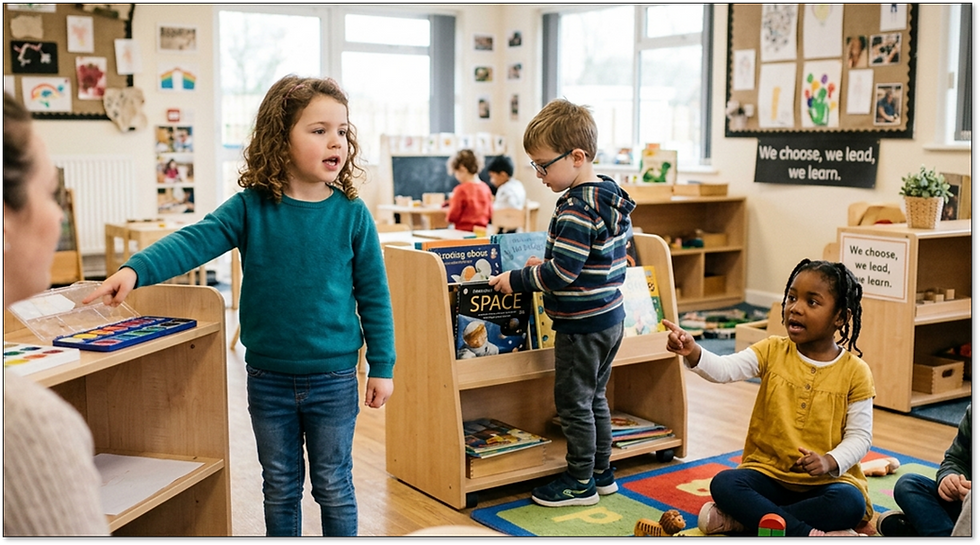
It is a term that appears regularly in early childhood literature, policy documents and professional discussions, yet many practitioners tell me they are unsure what it actually means in practice. It can sometimes feel like one of those academic phrases that everyone uses but few people define.
The reality is that children’s agency is not complicated. In fact, it sits at the heart of what many early years professionals do every day.
Understanding Agency
At its simplest, agency refers to a child’s capacity to act, make choices, influence their environment and participate in decisions that affect them.

Children are not passive recipients of education. They are active participants in their own learning, development and relationships. They bring ideas, interests, questions, emotions and intentions into every experience.
When we talk about children’s agency, we are recognising that children are not simply being shaped by the world around them; they are also shaping it themselves.
Agency is about seeing children as:
Competent
Capable
Active contributors
Decision-makers
Meaning-makers
This does not mean children should make every decision, nor does it mean adults step back entirely. Rather, it means adults respect children as individuals whose views, interests and choices matter.
Agency in Everyday Practice
Agency is often more visible than we realise.
A child deciding which resources to use in their play is demonstrating agency.
A toddler choosing whether to join a group activity is demonstrating agency.
A child negotiating roles in a pretend café is demonstrating agency.
A baby turning away when they have had enough of an interaction is demonstrating agency.
Agency is not reserved for older children. Even babies communicate preferences, make choices and influence the people around them.
The challenge for practitioners is noticing these moments and responding to them respectfully.
Agency Is Not the Same as Doing Whatever You Want
One common misconception is that agency means children are allowed to do whatever they choose.
This is not the case.
Children thrive within secure relationships, appropriate boundaries and thoughtfully designed environments. Adults still have important responsibilities to keep children safe, extend learning and provide guidance.
Agency sits alongside adult support rather than replacing it.

Think of it as a partnership:
Adults provide opportunities.
Children influence how those opportunities unfold.
Adults listen and respond.
Children contribute ideas and perspectives.
This balance is often where the richest learning takes place.
Why Agency Matters
Research consistently highlights the importance of participation, autonomy and belonging for children’s wellbeing and development.
When children experience agency, they are more likely to:
Develop confidence and self-esteem
Build independence
Strengthen problem-solving skills
Become resilient learners
Feel valued and respected
Develop a sense of identity and belonging
Agency also supports motivation. Children are naturally more engaged when they feel ownership over their learning and experiences.
As adults, we know how frustrating it can feel when decisions are constantly made for us. Children are no different.
Agency and the UN Convention on the Rights of the Child

Children’s agency is closely linked to children’s rights.
Article 12 of the United Nations Convention on the Rights of the Child states that children have the right to express their views on matters affecting them and for those views to be taken seriously.
Agency is one way we bring this right to life.
Rather than simply asking children for their opinions, we create environments where their ideas genuinely influence what happens next.
What Does Agency Look Like in an Early Years Setting?
A setting that values agency might:
Follow children’s interests when planning experiences
Offer meaningful choices throughout the day
Listen carefully to children’s ideas and suggestions
Adapt routines when appropriate
Involve children in decisions about their environment
Encourage problem-solving rather than providing immediate answers
View behaviour as communication
Prioritise relationships and dialogue

Importantly, agency is not something we “give” children.
Children already possess agency.
Our role is to recognise it, respect it and create conditions where it can flourish.
The Child in the Now
This idea connects strongly with the Child in the NOW model. Too often, children are viewed through the lens of what they will become rather than who they are today.
When we prioritise agency, we acknowledge children as people in the present moment. Their thoughts, feelings, interests and perspectives have value now, not simply because they prepare them for school or adulthood.
Agency invites us to slow down, listen more carefully and trust children as active participants in their own lives.
A Final Thought
Perhaps the easiest way to think about children’s agency is this:
Agency is the recognition that children are not merely passengers in their childhood; they are active participants in it.
When we listen to children, respond to their ideas and create opportunities for meaningful choice and participation, we honour their agency. In doing so, we create environments where children do not simply learn, they belong, contribute and thrive.
Reflective Question
If an observer spent a day in your setting, how many opportunities would they see for children to genuinely influence what happens around them?



Comments