

The Best Resource in an Early Years Setting? A Cardboard Box.

By Dr. Aaron Bradbury

Walk into almost any early years setting and you will see shelves carefully organised with resources: small world figures, construction sets, role play equipment, mark-making areas, carefully curated provocations. We talk often about quality environments, about investment, about enhancement. But, in the middle of all of this, one of the most powerful resources we can offer children is something that usually arrives by accident is a cardboard box.
It sounds almost too simple, ordinary or unremarkable. But that is precisely the point. A cardboard box does not arrive with instructions. It does not light up. It does not speak or not tell a child what it is supposed to be. Instead, it waits and in that waiting, it hands over power.
The moment a child encounters a box, something remarkable happens. It is no longer packaging; it becomes possibility. I have seen boxes transformed into racing cars with steering wheels drawn in felt tip, into rocket ships blasting off to the moon, into dens where children create their own small worlds and decide who may enter. I have seen children turn them into homes, into boats, into shops, into safe spaces to pause and regulate when everything feels just a little too much. The box becomes what the child needs it to be in that moment.
This is symbolic thinking in action, the ability to let one thing stand for another. It is the foundation of storytelling, of writing, of mathematics or an abstract thought. Yet it emerges not from a tightly planned adult-led task, but from an open-ended object that trusts the child’s imagination.
There is also something deeply democratic about a cardboard box. There is no “right way” to use it. No child is ahead. No child is behind. A box does not expose gaps; it invites contribution. The confident child may climb inside and declare it a pirate ship. The quieter child may sit within it and draw carefully on its sides. Another may cut windows, another may tape two together to make something bigger. Each approach is valid. Each approach is intelligent.
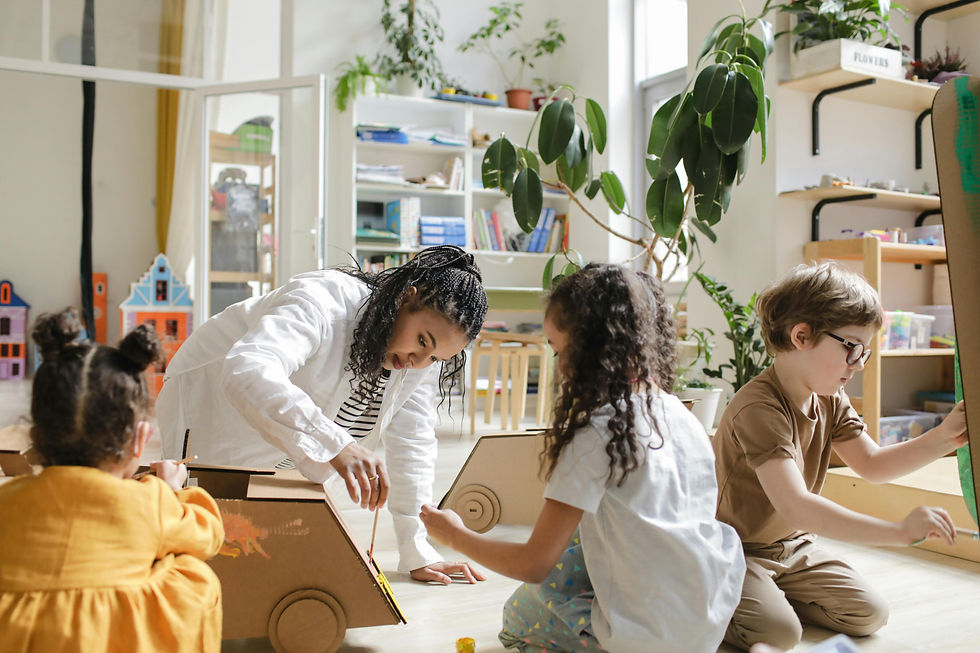
In a time when early childhood education can feel increasingly shaped by measurement and performativity, the cardboard box resists. It does not produce easily recordable outcomes. It does not fit neatly into a tick-box assessment and yet, within it, language flourishes as children negotiate roles and narrate stories. Mathematics appears as they measure, compare sizes, and problem-solve structural challenges. Physical development is visible as they climb, crawl, balance and lift. Personal, social and emotional development unfolds as they manage frustration when the tape won’t stick or when someone else wants the same space.
The learning is not absent. It is simply organic. There is also an important message here about consumerism. Early years settings are often under pressure to demonstrate quality through visible resources. New equipment can feel reassuring. But children do not necessarily need more sophisticated objects; they need more opportunity. A cardboard box reminds us that imagination cannot be bought. It can only be trusted.
When we offer a child a box, we are communicating something powerful. We are saying: I believe you can think. I believe you can create. I believe your ideas are enough.
High expectations are not always about accelerating children forward. Sometimes they are about holding steady and allowing depth and allowing time, allowing the child to lead. A cardboard box embodies that philosophy. It is simple, open and full of potential, just like the children who use it.
Perhaps the next time a delivery van arrives at your setting, instead of immediately flattening the packaging and sending it to recycling, I ask you to place the box in the environment. Step back. Watch what happens.

You may just discover that the most powerful resource in your provision was never in the catalogue at all.


Comments